Difference Between the ?, ?? and || Operators in JavaScript / TypeScript
# Context
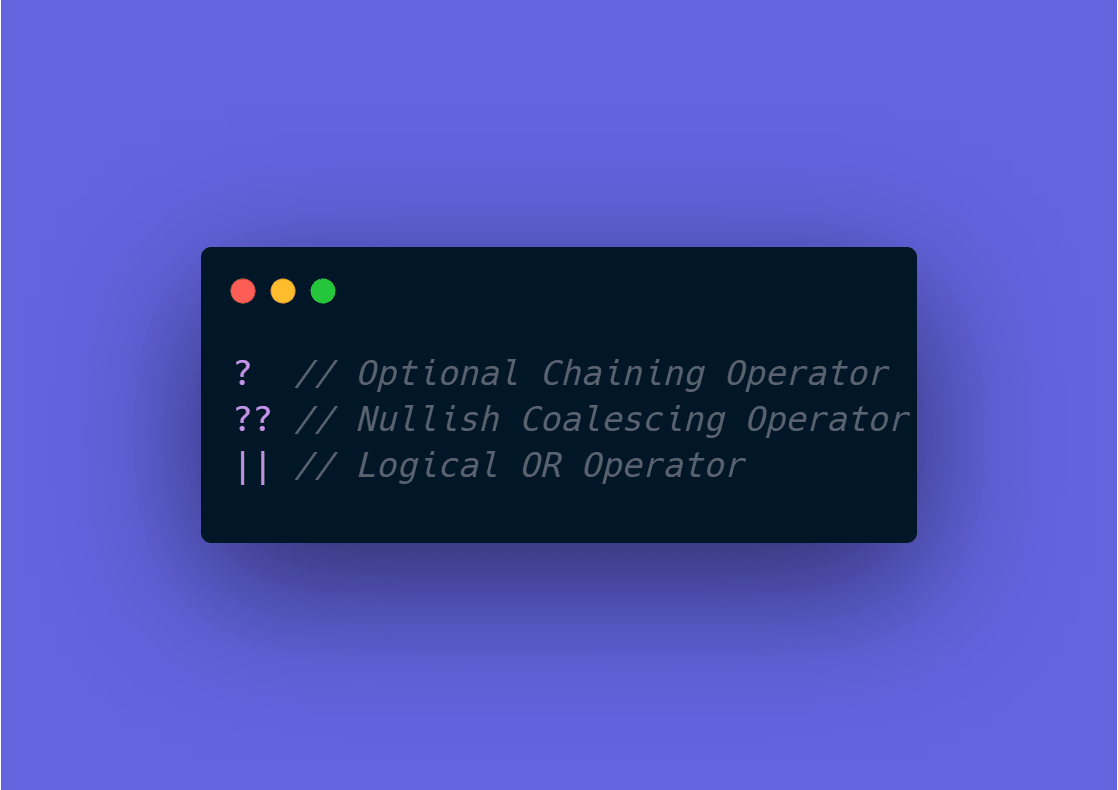
I believe every developer has had doubts about the differences between some JavaScript/TypeScript operators. That's why I made this quick and simple post about the differences between the ?, ?? and || operators. Check it out below
# ? - Optional Chaining
? -> Optional Chaining Operator.
Allows reading the value of a property located internally in a chain of connected objects without having to explicitly validate each reference in the chain.
The ?. operator works similarly to the . chaining operator, except that instead of causing an error if a reference is nullish (null or undefined), the expression short-circuits and returns with a value of undefined. When used with a function call, it returns undefined if the executed function does not exist.
This results in shorter and simpler expressions when accessing chained properties when there's a possibility of a reference being non-existent. This can also help when exploring the content of an object when there's no guarantee of certain required properties existing.
Example
const user = {
  id: 13,
  name: 'Thayto',
}

console.log(user?.name) // John
console.log(user?.fullName) // undefined, application won't break.
console.log(user.fullName) // TypeError: Cannot read property 'fullName' of undefined, application breaks.
# ?? - Nullish Coalescing
?? -> Nullish Coalescing Operator.
Is a logical operator that returns its right-hand side operand when its left-hand side operand is null or undefined. Otherwise, it returns its left-hand side operand.
Example
console.log(13 ?? 'not found') // 13
console.log(0 ?? 'not found') // 0

console.log('Dri' ?? 'not found') // "Dri"
console.log('' ?? 'not found') // ""

console.log(true ?? 'not found') // true
console.log(false ?? 'not found') // false

console.log(undefined ?? 'not found') // "not found"
console.log(null ?? 'not found') // "not found"
# || - Logical OR
|| is the Logical OR Operator
The Logical OR expression is evaluated from left to right, it is tested for possible "short-circuit" evaluation using the following rule:
(some truthy expression) || expr is short-circuit evaluated to the truthy expression.
Short-circuit means that the expr part above is not evaluated, therefore any side effects of doing so do not take effect (for example, if expr is a function call, the call never occurs). This happens because the value of the operator is already determined after evaluation of the first operand.
Example
console.log(13 || 'not found') // 13
console.log(0 || 'not found') // "not found"

console.log('Dri' || 'not found') // "Dri"
console.log('' || 'not found') // "not found"

console.log(true || 'not found') // true
console.log(false || 'not found') // "not found"

console.log(undefined || 'not found') // "not found"
console.log(null || 'not found') // "not found"